Saturday, March 28, 2015

Reader Question: How Are Salary Contracts Tied to CPI?

Question

On March 24, I received a letter in the mail [view imagefrom an observant person who asked if Cathy Dremel's statements about tying salary contracts to cost of living (CPI) were true.

These links to the BATV ViewPoint show and League of Women Voters Forum begin with the exact statement asked about in the letter:


While the CPI statement is technically true, it is misleading. The portion of the contracts linked to CPI is the least significant part in determining how teachers get paid. Currently, the school district's expenses are projected to outstrip revenues, contrary to what the Board President claims.

Note: This post is not a commentary on the equity of teacher pay. I believe that teachers deserve every penny they're worth.

Step and Lane: Crash Course

The most common way teachers get paid in our state is according to the contract negotiated between the School Board and the Teachers' Union which includes a grid system commonly called "step and lane". The contract specifies exactly how much a teacher's salary will be based on the number of years of teaching experience as well as how much graduate education has been completed. The more years of service or the more education received, the higher the salary will be. These contractual values are not related to CPI at all, and the typical increase is far greater than CPI has been over the past decade.

You may view the current teachers' agreement here, and page 56 has the step and lane grid. This step and lane page, specifically, may be viewed at this link.

The CPI Factor

So where does cost of living factor into how teachers get paid? CPI determines how much the contract grows every year. A step is equal to the number of years teaching, and the lane is based on level of education (e.g. BA8 is Bachelor's Degree plus 8 hours towards a Master's Degree). The years of service and hours of education are two dimensions that set a teacher's salary, and CPI adds a third dimension to this grid. Teachers will get the step increase along with the CPI increase every year, and most of them have the option to move over a lane by going to graduate school[1].


FY2015 Contract
FY 2016 Contract

Teachers move down a step every year
   CPI   
Adjustment
-->
0.23%


Teachers move over a lane with education

Pay Raise Heatmaps

So the question remains, what kind of raises can teachers expect every year? Even without the CPI adjustment, salaries increase from 0.3% to 4.8%. The first grid below shows the contracted raise for every cell in the chart when just a step (ordinary yearly increase) occurs. The second grid shows the percentages including the CPI component, and the last grid shows what a raise looks like if a teacher completes 8 hours of graduate work and moves over a lane.

Percentage Increases (3.5 = 3.5%) for a Step [One More Year Experience]

Percentage Increases for a Step with 2016 CPI Adjustment
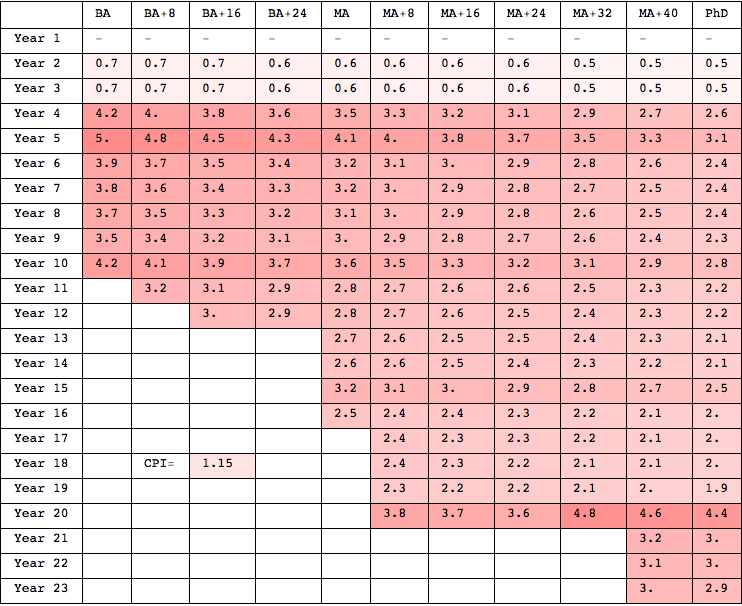
Percentage Increases for a Step and Lane Move with 2016 CPI Adjustment


Conclusion

The concerns raised in the original letter are exactly right, and we haven't even discussed issues like benefits. Health care[2] is a problem for every company in the U.S. since costs have been rising over 10% per year for more than a decade. That is a challenge for us all.

All of this is the reason that, as a school district, we need to be as fiscally responsible as possible with the funds we do have. What's most important is being open and honest with the community so that we accurately understand the challenges of the future. Trying to claim that there is no fear of expenses outstripping revenues is the exact type of dishonesty we don't need. My observation is that this is a pattern coming out of the district, and that's why an important part of our platform is to increase transparency.

Be sure to Vote GRO on April 7 for openness, honesty and transparency. Batavia deserves to be fully informed with the full truth.


Footnotes
1. It is worth noting that the School District will reimburse up to $150 per credit hour for teachers to pursue this continuing education. See page 34 of the CBA, or look at the pages directly here.
2. Health Care is also covered in the CBA on pages 32 and 33.

Tuesday, March 17, 2015

Tax Bill, Inflation, Income, and Extension

The school district has prepared a graph to show that tax growth is in line with CPI ("cost of living"), but the presentation is lacking in two regards. First, the starting year was specially chosen to support the conclusion, but it misses the bigger picture regarding the bigger picture of Batavia's financial health. See what happens when you move the starting point just one year; then the picture is not as rosy:


From 2007 to 2014, the amount of taxes the district has extended has increase by  36.8%.  The average residential tax bill (the district's portion) has increased by 20.3%.  Overall increase from inflation, according to the Consumer Price Index (CPI), has been 16.6%. Batavia's Median Household Income has increased by 1.5%.
For the heart of Batavia, the increased tax burden has well out paced their household income.

Tuesday, January 27, 2015

Batavia School District: Always Growing

Residents of Batavia are quickly reaching a tipping point. The typical homeowner's tax load has grown at an accelerating rate, and many have expressed frustration and pain over this crushing burden.

Taxing Times

These graphs demonstrate how much the district has required of its community in the previous decade.


This graph represents the amount of Tax Levy money used in the district's Fiscal Year Budget

Beginning with the value of the levy in 2004 (~$35 Million), the level of economic growth and inflation (CPI) indicates that the levy should have only increased to about $44 Million today, yet Batavia finances the district from local property at a level that's over $65 Million. Our community is taxed 47% above the level that would have matched natural economic growth.


Student growth cannot account for the dramatic rise in expense. Indeed, enrollment has been declining and is expected to continue declining for the foreseeable future.

Simultaneously, home values have stagnated, so the tax rate for every home and business has skyrocketed.


This is unsustainable, and the community is in a precarious position: if taxes continue to rise, property values will diminish. As property values drop, the district will need to extract more value from each property, and this negative feedback loop will eventually bankrupt the school district and its residents.

Follow the Money

A natural question to ask is, "Where is all this money going?" Some of it is going toward education in the classroom, paying teachers, and maintaining daily operations. However, non-education expenses have risen faster than the expenses directly related to education.

The spike is due to the 2007 referendum, but non-education expenses continue to grow per student while education related expenses have remained flat.

One area that has clearly grown is administration--it has ballooned in particular since TIF District #2 Expired. The implication of these charts is that it must be approximately 50% harder to administrate than only two years ago.


Community Advocates

Batavia needs a School Board who will work to keep expenses down, operations streamlined, and ensure that every dollar spent is justified.

Vote GRO (Gabriel, Rechenmacher, Olache) to hold the district accountable as we seek a sustainable future.

Monday, January 19, 2015

Referendum Mandate

Thanks to the expiration of Aurora TIF #2, the Batavia School District started receiving an additional $6 million in revenue per year. The Board described this as, "the type of windfall that districts dream of" [Finance Committee Meeting, 22 October 2013].

Many in the community asked the School Board to refund some of this tax money to lower the growing property tax burden. These voices received a common reply, "These funds were anticipated in the budget adopted in September 2013 and were the source of approving the additional staff and capital improvements included within that budget." The Board never intended to lower the levy; spending and taxation has only increased.

Not long after receiving the dreamy windfall, the Board proposed a $15 million bond referendum for capital improvements. Batavia resoundingly voted NO to the "advisory question." The message the board received from the 75% NO vote was that the community was opposed to debt [1]. The residents of Batavia are tired of their tax burden, they're tired of the accelerating spending, and they're tired of the justifications that come from a Board that is out of touch with the community they represent.

The 8,000 voters who said NO care about more than debt. The landslide vote was a mandate to the Batavia School District to manage its finances and control its spending.

Every School Board Member takes an oath:


  • I shall respect taxpayer interests by serving as a faithful protector of the School District’s assets;
  • I shall encourage and respect the free expression of opinion by my fellow Board members and others who seek a hearing before the Board, while respecting the privacy of students and employees;
  • I shall recognize that a Board member has no legal authority as an individual and that decisions can be made only by a majority vote at a public Board meeting; and
  • I shall abide by majority decisions of the Board, while retaining the right to seek changes in such decisions through ethical and constructive channels.

  • It is time the School Board remember the oath they took and represent the interests of Batavia's taxpayers.

    [1] Mentioned in the Finance Committee Meeting on 11/13/14 - https://www.youtube.com/watch?v=vDPdZ6tJOMo